Love is Enough: William Morris and Andy Warhol

Birmingham Museum and Art Gallery | 25 April – 6 September 2015

Admission: Standard entry £7

Jeremy Deller celebrates two groundbreaking artists, drawing parallels between their inspiration, politics and aesthetics.

Andy Warhol, Dame Elizabeth Taylor, 1967 © 2014 The Andy Warhol Foundation for the Visual Arts, Inc. / Artists Rights Society (ARS), New York and DACS, London.

Andy Warhol, Dame Elizabeth Taylor, 1967
© 2014 The Andy Warhol Foundation for the Visual Arts, Inc. / Artists Rights Society (ARS), New York and DACS, London.

It may seem an unlikely pairing, but Morris and Warhol have rather a lot in common, according to Jeremy Deller. In this unorthodox show the artist presents a new reading into the work of two of his greatest inspirations, displaying prints, tapestries, publications and sketches from throughout their respective careers.

Hugely influential in their own lifetime, both Morris and Warhol began their creative ventures in commercial sectors, before redefining the role of the artist in relation to wider society. Morris was a passionate advocate for social change, strongly believing that the labour and beauty of art could revolutionise the social structure in Britain. He used his textile company to produce stunning designs that embodied the ethos of the Arts and Crafts movement, harking back to form of mediaeval romanticism.

Warhol’s own political agenda is often overlooked in the general perception of his work, and is well known for his obssession with the idea of the icon, especially in terms of Hollywood stardom. His incredible influence over the merging of fame, media and high art can still be felt today, but his concept of ‘Commonism’ – in which the banal and everyday is celebrated and art is available and equal to all – is sometimes not fully contemplated.

This exhibition encompasses four areas that show the artists’ shared inspiration, methodologies and aesthetics: ‘Camelot’, ‘Hopes and Fears in Art’, ‘A Factory it Might Be’ and ‘Flower Power’. Infamous Warhol prints such as Flowers are mounted onto classic Morris wallpaper, allowing for new and exciting readings into the works that have never been seen before.  – Art Fund

Birmingham Museum and Art Gallery
Chamberlain Square
Birmingham West
Midlands
B3 3DH
0121 303 1966
www.bmag.org.uk
Opening Times:

Mon – Thu, 10am – 5pm
Fri, 10.30am – 5pm
Sat – Sun, 10am – 5pm

Marlene Dumas: The Image as Burden

Tate Modern | 5 February – 10 May 2015

Admission: Standard entry £14.50

The artist’s depictions of the human figure reflect upon love, death, gender, sexuality and the influence of mass media and celebrity.

For Marlene Dumas portraiture is not part of a wider oeuvre, portraiture is a single obsession. Even as a child she sought only to represent the face or figure. ‘I never did a tree,’ she told the New York Times in 2008.

Marlene Dumas, The Widow, 2013

Marlene Dumas, The Widow, 2013

And yet she is not like other portrait artists. Rarely working from life, she finds her subjects in newspapers and magazines or recreates her daughter from old photographs. She admits to knowing little about colour, instead using it intuitively. Her work – intense and at times unsettling – captures a mood as much as a physical presence. For example, the series of weeping women she produced in the year after her mother died, her heartbreak spilling out across the canvas.

From her earliest sketches to newly finished portraits, Tate Modern presents the most significant retrospective of Dumas’s career to be staged in Europe. It takes its name from her 1993 work depicting one figure carrying another. The artist sees a connection between the subject of the painting, and the painter who carries the weight of her subject.

Terrorists, movie stars, deformed babies and strippers are captured in inky swirls of paint. Never entirely literal, for Dumas these portraits are a means by which to delve into the murky depths of the human experience. Race, sexuality, oppression, torture and death sit firmly within her scope of exploration. As Dumas told W Magazine before her retrospective in Los Angeles, ‘I am interested in what a human being is capable of.’ – The Art Fund

Tate Modern
Bankside
London
SE1 9TG
020 7887 8888
www.tate.org.uk
Opening Times: 

Sun – Thu, 10am – 6pm (last admission to special exhibitions is at 5.15pm)
Fri – Sat, 10am – 10pm (last admission to special exhibitions is at 9.15pm)

Goya: The Witches & Old Women Album

The Courtauld Gallery | 26 February – 25 May 2015

Admission: standard entry £7.50

Revealing Goya’s obsession with visions, nightmares, superstitions and mortality.

Ravaged by a debilitating near-fatal illness and all-but completely deaf, Francisco Goya was a changed artist in middle age. While he continued as a court painter to the Spanish crown, privately he worked on a series of albums where he recorded his increasingly dark thoughts.

Francisco Goya, He can no longer at the age of 98, c. 1819-23

Francisco Goya, He can no longer at the age of 98, c. 1819-23

The drawings they contained – populated with nightmarish figures, superstitious tales and horrific deaths – were never intended to be seen beyond a small circle of friends. They are brutally indicative of his mental state; at the same time he had isolated himself in a remote house outside of Madrid where he covered the walls with his ‘Black Paintings’.

After his death in 1828 the eight albums were broken up and scattered across museums and private collections. This is the first exhibition to bring together all the drawings from the Witches and Old Women album – previously misunderstood as individual drawings rather than a single project. The final surviving page is particularly poignant: an elderly figure leaning on two sticks entitled ‘Can’t go on any longer…’. – Art Fund

The Courtauld Gallery
Somerset House
Strand
London
WC2R 0RN
020 7848 2526
www.courtauld.ac.uk
Opening Times:

Daily, 10am – 6pm


History is Now: 7 Artists Take on Britain

Hayward Gallery |10 February – 26 April 2015

Admission: Standard entry £10.90

Seven artists reflect on British cultural life from 1945 to the present day.

As the Second World War neared its conclusion, Britain approached a watershed moment. The post-war world would be a very different place, and Britain’s economy, still labouring under outdated Victorian notions of industry, would struggle to compete in the new global market.

One month after V-E Day, the recently founded Council of Industrial Design announced an exhibition to reflect on Britain’s past industrial successes and create a blueprint for its future. Titled ‘Britain Can Make It’, the exhibition was distinguished by a 13-foot plaster egg at its entrance – a reference to one of the exhibition’s central exhibits, Misha Black’s ‘Birth of an Egg Cup’, but also symbolic of the planned rebirth of British industry for a brave new era. Seven decades later, the UK finds itself on the brink of another turning point, with new questions and new uncertainties.

Simon Fujiwara

Simon Fujiwara

Today’s Britain isn’t post-war, but post-recession, post-riot, post-referendum. In the lead up to the 2015 general election, the Hayward Gallery has taken inspiration from the Council of Industrial Design’s exhibition for a new show reflecting on key moments in British culture since the end of the Second World War.

Seven artists – Richard Wentworth, John Akomfrah, Jane and Louise Wilson, Hannah Starkey, Roger Hiorns and Simon Fujiwara – have each been invited to curate a ‘chapter’ of the exhibition, selecting artworks and objects that capture pivotal events from the last 70 years, from the emergence of the surveillance state to the mad cow disease epidemic. – Art Fund

Hayward Gallery
Southbank Centre
Belvedere Road
London
SE1 8XX
020 7960 4200
www.southbankcentre.co.uk/hayward
Opening Times:

Mon, 12noon – 6pm
Tue, Wed, Sat, Sun, 10am – 6pm
Thu, Fri, 10am – 8pm

Designs of the Year 2015

Design Museum | 25 March – 23 August 2015

Admission: Standard entry £13

Among the 76 nominated projects for 2015 are an off-grid eco toilet, microchips that mimic human organs, a campaign promoting ugly vegetables and a book printed without ink.

A strong theme for this year is the desire to harness new technologies to solve long-standing problems; from the world’s first lab for 3D printing prosthetic limbs, to a sensor which connects to a cow’s tail and texts the farmer when calving is imminent. The jury includes sculptural artist and designer of the Olympic tower, Anish Kapoor, and eminent architect and Harvard professor, Farshid Moussavi.

Megafaces pavilion and kinetic facade, Sochi winter olympics 2014, Asif Khan

Megafaces pavilion and kinetic facade, Sochi winter olympics 2014, Asif Khan

Design Museum
Shad Thames
London
SE1 2YD
020 7940 8783
www.designmuseum.org

Opening Times: 

Daily, 10am – 5.45pm (last admission 5.15pm)


Constructing Worlds: Photography and Architecture in the Modern Age

Barbican Art Gallery | 25 Sep 2014 – 11 Jan 2015

Admission: standard entry £12

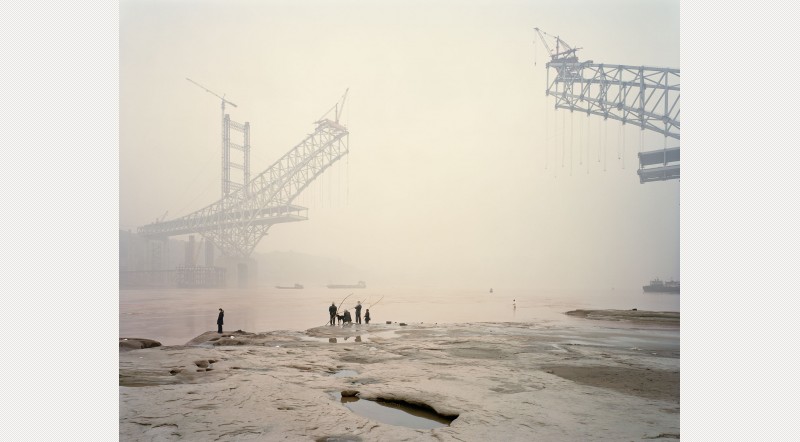
Key moments from the 20th and 21st century are seen through architecture; the birth of the skyscraper in New York, the rapid urbanisation in China, the devastating effects of the war on Afghanistan. These images not only document the built landscape, but reveal the wider social contexts that have necessitated its transformation.

Concentrating on the work of 18 leading photographers from the last 80 years, the exhibition begins in 1935 with Berenice Abbott, who captured New York’s transformation into a modern metropolis. From there, it journeys through affluent California in the 1940s, India’s independence in the 50s, the decline of industrial Europe in the 60s and 70s and culminates in an exploration of the contemporary urban experience. Featured artists include Lucien Hervé, Ed Ruscha, Hiroshi Sugimoto and Guy Tillim, among others. – Art Fund

Nadav Kander - Chongqing XI

                                                 Nadav Kander – Chongqing XI, Chongqing Municipality, 2007

Barbican Art Gallery

Level 3

Barbican Centre

Silk Street

London

EC2Y 8DS

020 7638 8891

www.barbican.org.uk

Opening Times:

Art Gallery
Sun–Wed: 10am– 6pm
Thu–Sat: 10am–9pm
Bank Holidays:1 2noon – 6pm
Bank Holiday Fridays: 10am–9pm

The Curve
Sat– Wed: 11am – 8pm
Thu–Fri: 11am-9pm
Bank Holiday Mondays: 12noon –8pm
Bank Holiday Fridays: 12noon–9pm

Book online via the Barbican website

Adventures of the Black Square: Abstract Art and Society 1915 – 2015

Whitechapel Gallery |15 January – 6 April 2015

Admission: standard entry £9.95

December 1915 was a key moment in the history of Abstract art. The Last Futurist Exhibition of Paintings: 0.10 opened in St. Petersburg with a display of paintings by Kazimir Malevich featuring blocks of colour floating against white backgrounds. Powerfully reductive, these were the very first examples of geometrical abstraction. One hundred years later, Black and White. Suprematist Composition from 0.10 in 1915, is the opening piece of this exhibition at Whitechapel.

Abstraction had been gathering pace in Europe since 1911, thanks to a group of painters who believed a new style of art was needed to encompass the fundamental changes taking place in technology, science and philosophy. Rejecting methods which focused solely on reproducing visual objects, they instead used colour, shape and texture to create new images.

Here the gallery brings together paintings, sculptures, film and photographs which trace the development of abstraction over the last century. As well as exploring its intimate connection with society. – Art Fund

Gabriel Orozco, Light Signs #1 (Korea)

Gabriel Orozco, Light Signs #1 (Korea), 1995

Whitechapel Gallery

77-82 Whitechapel High Street

London

E1 7QX

Tel: 020 7522 7888

www.whitechapelgallery.org/

Art From Elsewhere

Gallery of Modern Art (GoMA) | 24 Oct 2014 – 1 Feb 2015

Admission: Free entry to all, Free exhibitions to all.

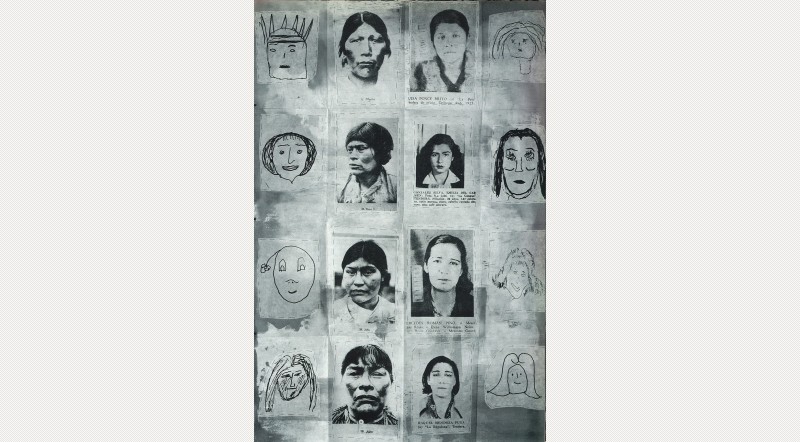
Art From Elsewhere is testament to the talent and diversity of artists working across the world today. The exhibition – a collaboration with Hayward Touring – is being shown at venues across the UK, starting here at GoMA, Glasgow. The works were acquired through an Art Fund scheme that sought to enhance collections of international contemporary art at museums and galleries outside of London, of which GoMA was one of the chosen partners.

Featuring painting, sculpture, installation, video and photography, the exhibition changes from city to city in order to draw out the full range of each of the collections. Featured artists for this display include Peter Hujar, Paulo Bruscky, Ana Mendieta, Kara Walker and Amar Kanwar. Their works address an array of important topical issues; life in conflict zones, oppressive government regimes, the advent of capitalism and post colonial experiences. – Art Fund

Eugenio_Dittborn -The 13th History of the Human Face

                                                   Eugenio_Dittborn -The 13th History of the Human Face

Gallery of Modern Art (GoMA)
Royal Exchange Square
Glasgow
Strathclyde
G1 3AH
0141 287 3050
www.glasgowmuseums.com
Opening Times:
Mon – Wed, Sat, 10am – 5pm
Thu, 10am – 8pm
Fri, Sun, 11am – 5pm

Anarchy & Beauty: William Morris and his Legacy, 1860-1960

National Portrait Gallery |16 Oct 2014 – 11 Jan 2015

Admission: standard entry £12.70

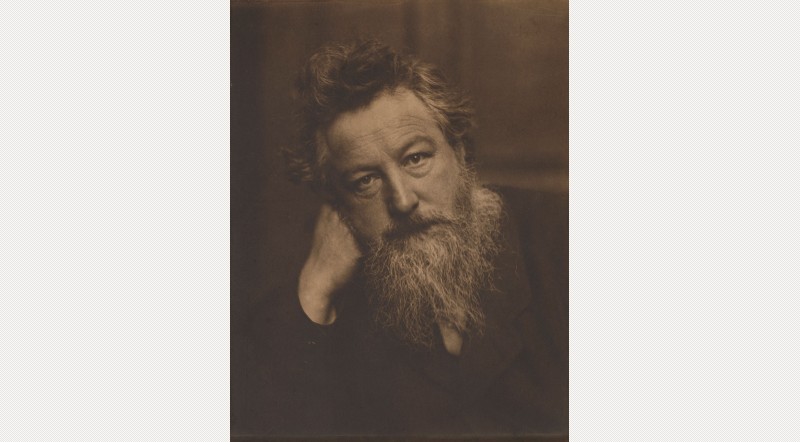
Art for the people’ – William Morris’s revolutionary call to action that redefined creativity in the Victorian era, and which helped to forge new paths for subsequent generations artists, designers, academics and philosophers. Spanning from the early origins of the art-inclusive movement to its manifestation in the 1960s, this show explores Morris and his extraordinary legacy. Explore the surprising and well-known relationships between William Morris’ illustrious circle of friends with our connections map.

Morris was closely associated with the convention-defying Pre-Raphaelite artists and other radical thinkers such as the critic John Ruskin, who believed that all human beings have artistic potential. The exhibition includes items produced by key members Morris’s inner circle, including lifelong collaborator Edward Burne-Jones, the painter Dante Gabriel Rossetti and the female artists and designers he accepted as co-practitioners at a time where women had few rights.

Extending beyond his lifetime, the show charts the continuation of Morris’s idealism over the next 200 years. It explores the Garden City movement which pushed for ‘good design’ to be made available to a wider market in the Edwardian era, the ethical crafts produced by anti-materialist Bernard Leach and his contemporaries in the 1920s and 30s, and the establishment of the government supported Council of Industrial Design in the post-war years. – Art Fund


Frederick Hollyer - WilliamMorris

                                                                        Frederick Hollyer – WilliamMorris

National Portrait Gallery

St Martin’s Place

London

WC2H 0HE

020 7306 0055

www.npg.org.uk

Opening Times:

Sat – Wed,10am – 6pm

Thu – Fri, 10am – 9pm

Allen Jones RA

Royal Academy of Arts | 13 Nov 2014 – 25 Jan 2015

Admission: standard entry £10

Film, fashion design, theatre, citylife, advertising – these are the subjects of Allen Jones, whose satirical brand of pop art is created using distinctive storyboarding techniques. Works date back to the 1960s when Allen started out as a student at the Royal College Art alongside David Hockney, Derek Boshier, Peter Phillips and Ron Kitaj.

Although Jones was later expelled, this cohort helped establish a new visual language for British Art – drawing heavily on contemporary culture and the human figure. Jones is particularly interested in the representation of women, and has become known for his erotic sculptures in which he uses their forms as human furniture. Examples are shown here alongside his portraits of contemporary female icons, such as Darcey Bussell and Kate Moss. – Art Fund

Allen Jones - First Step

                                                                                    Allen Jones – First Step

Royal Academy of Arts

Burlington House

Piccadilly

London

W1J 0BD

020 7300 8000

Opening Times:

Mon – Thu, Sat – Sun, 10am – 6pm, Fri, 10am – 10pm, Closed 23 Jan,